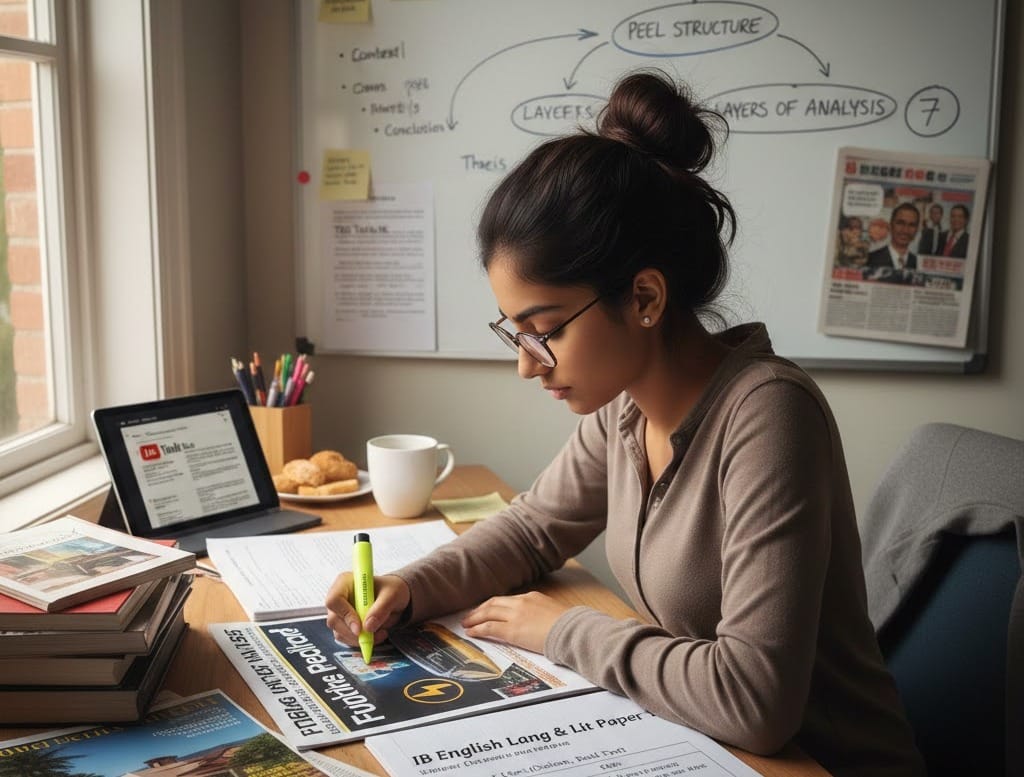
How to write an IB English Language and Literature Paper 1
What is IB English?
Have you been struggling to get that high 7 in your IB English Language and Literature class?
The International Baccalaureate (IB) Language course is designed for students aged 16-19 to develop a deeper understanding of concepts and principles in English. For your Language A class, you have the opportunity to either take the Literature or Language and Literature courses. Language and Literature course offers a comprehensive coverage of both literary and non-literary mediums of text and allows you to understand both the context and the outcome of these texts.
Today we will take a deeper dive into paper 1 and how you can get a 7 on the exam.
Structure of the Paper 1
The IB English Paper 1 consists of writing a guided analysis of a text. If you are at standard level (SL), you will only need to write about one text, however if you are at higher level (HL), you will need to write two separate essays analyzing two different texts.
Paper 1 will traditionally be examining your ability to analyse the “Language” element of the exam. Thus, the text types will be things such as: magazine articles, speeches, advertisements, brochures and many more. Typically, at least one of the elements will have a visual component such as a cartoon or a photo.
For SL students you will have 1 hour and 15 minutes to complete the task, whereas for HL students you will have 2 hours and 15 minutes to write your two essays.
Now that we’ve looked at what the structure is, let’s take a deeper look into how to successfully achieve a 7 in your exam. For our Paper 1 we recommend a four pronged approach, involving separate layers of analysis. All of these together will help you write a stronger paper 1.
What you see
Although you may feel rushed for time, planning is a crucial part of your essay writing and it is essential that you give it a sufficient amount of time.
In your first level of analysis you want to be looking for the immediate things to talk about. For example, if it’s an image or a photo, what is the use of colour? Is there text that is in bold?
You want to look for things that might catch your eye and see how to move on from there.
For the moment, try not to concentrate too much on what it may mean but rather just focus on identifying important features so you can try and formulate arguments and further analysis later on.

Literary Devices
Next, you want to consider any possible literary devices and how they may connect to some of the initial things you saw.
In this instance you may also want to consider other elements beyond the initial level of analysis. For example, what technique is the text using- is it imagery? symbolism? and so on…
Once you have identified all of the different techniques, you can highlight them in the image or text, or make a list of all of them to the side. Placing them all together will allow you to see if there are any common themes that arise.
Explain
Now that you have identified all of the techniques you want to talk about and began observing some common themes, let’s think about explaining the techniques.
If we are thinking back to our point, evidence, explanation and link (PEEL) structure for paragraphs – a tried and tested method – this element would be to tackle the second “E”: explanation. This structure will be useful for all of your essay writing subjects, however it will be particularly useful in your IB English papers 1, 2 and IAs. For more information on how to structure your paragraphs for another assignment, check out our tips on how to write a paper 2 for IB English Language and Literature.
For the explanation portion, try to identify what these techniques are doing and what their purpose is. For example, if the advertisement uses a lot of red, is that red being used to connote romance or anger? Or if the symbol of lightning is being alluded to or drawn, is that referring to energy or power?
Once you write down these explanations next to your techniques you will be able to get a better sense of how to group your ideas thematically. Try to extract or underline any big or recurring ideas that you see. Finally you can group techniques/ common ideas together and come up with three general themes that will be used for your analysis.
After you have finished this you are now on your way to writing.
Write
For the main portion of the essay, you want to think about writing 3 paragraphs based around the themes you found in your planning stage. With this, remember to follow your tried and tested PEEL structure, you already have your P, E and most of your second E, so you’re only missing one last letter.
However, one thing you want to remember – this is where your fourth layer of analysis comes in – is what effect does it have on the reader? All too often students forget to move past the third layer of analysis, and only seem to consider what a technique might connote or attempt to show. Nevertheless, as a student you need to remember that all of the choices made by the author were intentional, so why would the author choose to do this for a specific audience?
Let’s use one of our previous examples. Let’s say that a thunderbolt is being used in an advertisement for a new car. In our previous layers of analysis we were looking at the effects of devices and authorial choices in isolation. However, now you want to think about their effect in the context of both the text type and the audience. So although a thunderbolt may symbolise energy, in this context it may be used to portray power, which may appeal to an audience who wish to have a car that is not only extremely potent but that may also help assert their power and dominance in the social sphere.
Connecting to a more in depth analysis will help push your paper 1 to a 7.
Don’t forget
Lastly, although not the primary components, do not forget about your introduction and conclusion.
In your introduction, make sure to talk about the context, purpose and include your thesis statement. A thesis statement should be a roadmap to what you will be talking about in your essay.
Jumping straight to the end, your conclusion should wrap up all of the main ideas and topics you have covered. As a rule of thumb, include one sentence per paragraph which restates your findings. Remember to never include new information in your conclusion.
Conclusion
Paper 1 can seem like a daunting task, but practicing this structure, and repeating it multiple times with different sources will give you the confidence needed to ace your exams in May.At Aegis Advisors, we specialize in guiding students through the intricate world of IB English, contact us to start your tutoring journey today!